Smart Systems Laboratory (SSL) • ENSIAS

Doctoral Research Agenda & Intellectual Pillars

Bridging Cybersecurity, Graph Deep Learning, and Cryptographic Verification to build resilient trust ecosystems for autonomous devices.

Social IoT Trust Architecture and Defense Schemes
Core Dissertation Subject Relationship-Layer Security Edge-Native Complexity: O(k²) Zero-Knowledge Verification

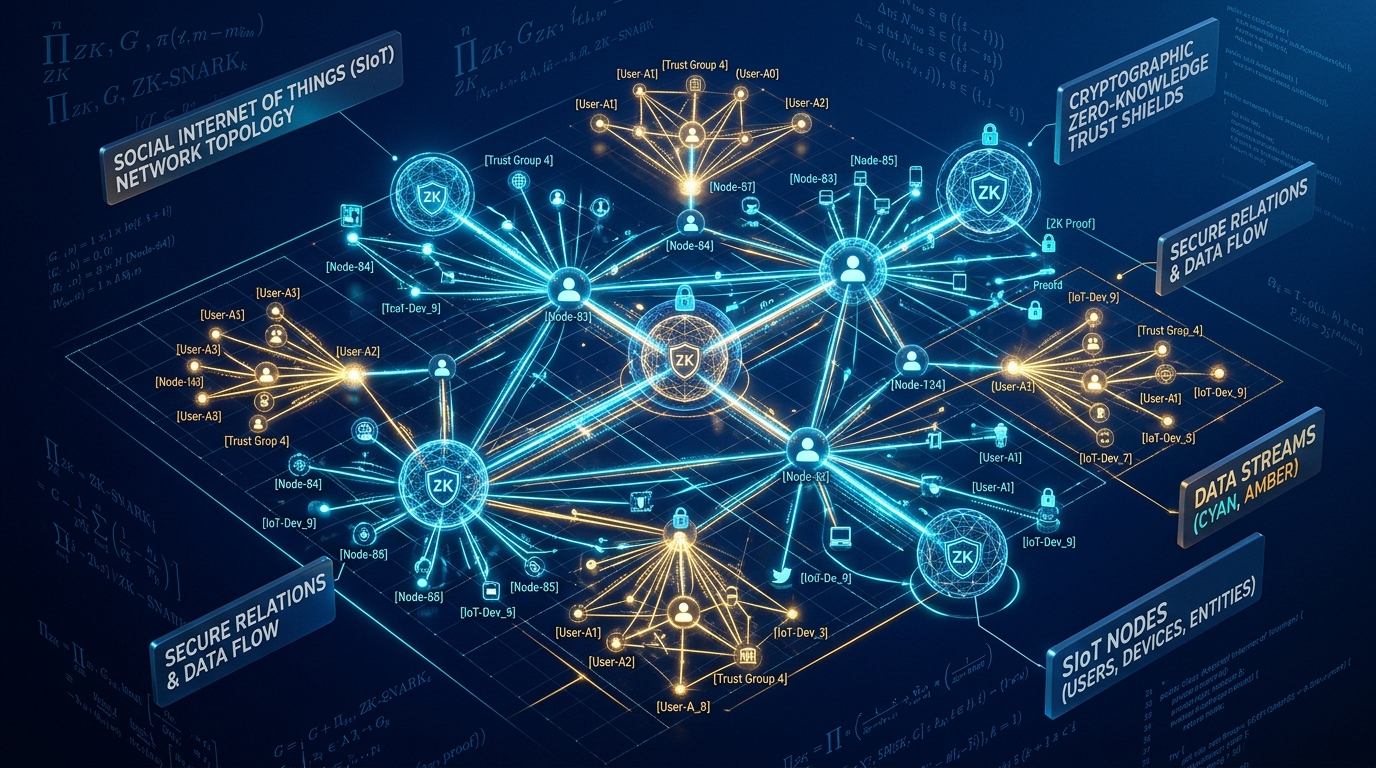
Unified Defense Architecture: From Graph Collusion to Cryptographic Proofs

Conventional IoT security paradigms focus strictly on physical device integrity, cryptographic key distribution, and link-layer encryption (AES/CCM). However, in modern Social Internet of Things (SIoT) and Social Internet of Vehicles (SIoV) environments, adversaries exploit the social relationship layer itself—crafting synthetic relationships, executing on-off behavioral switching, or poisoning recommendation paths without breaching physical nodes.

Our doctoral investigation formalizes these relational exploits, designs edge-native topological penalties (the Structural Diversity Penalty), constructs continuous-time relational deep attention networks, and incorporates non-interactive zero-knowledge proofs (zk-SNARKs) to establish private, robust decentralized trust.

Five Foundations

The Five Intellectual Pillars

A comprehensive breakdown of the core methodologies underpinning our published and ongoing doctoral works.

01

Social IoT & Decentralized Trust Management

Autonomous service discovery and relationship navigation without cloud authorities.

Investigating how heterogeneous edge devices autonomously form and traverse social ties—such as Parental Object Relationship (POR), Ownership Object Relationship (OOR), Co-Location Object Relationship (CLOR), Co-Work Object Relationship (CWOR), and Social Object Relationship (SOR). We formulate decentralized trust propagation models that verify peer dependability and delegate tasks without centralized intermediaries.

  • Formalizing multi-relational SIoT interaction graph topologies.
  • Transitive multi-hop trust computation with localized evaluation.
  • Elimination of single points of failure in edge computing setups.
02

Adversarial Threat Modeling & Relationship Attacks

Pioneering threat models against attacks targeting the social trust fabric.

Uncovering exploits targeting social ties rather than device silicon. We formally introduced and taxonomized the Fake Relationship Attack (FRA)—where collusive nodes forge synthetic social edges to illegitimately inherit trust—as well as analyzing Trust Manipulation Attacks (TMA) where nodes alternate between benevolent and malicious behavior to bypass exponential decay defenses.

  • First formal characterization and taxonomy of the Fake Relationship Attack.
  • Mathematical demonstration of exponential trust decay vulnerabilities.
  • Empirical proof that physical link-layer crypto fails against social exploits.
03

Continuous-Time Dynamic Graphs & Relational Attention

Deep graph learning over asynchronous edge event streams.

Developing neural trust architectures capable of processing irregular, continuous event streams. Leveraging Continuous-Time Dynamic Graphs (CTDG), Multi-Head Self-Attention, and Temporal Graph Networks (TGN) with semantic relational masking to defeat long-delay behavioral defections and adversarial GAN temporal mimicry.

  • Multi-Head Self-Attention across continuous-time interaction streams.
  • Isolating GAN-generated Pareto temporal mimicry with AP = 0.9707.
  • Edge-optimized 0.17 ms inference latency on ARM processors.
04

Privacy-Preserving Verification (zk-SNARKs)

Resolving the privacy vs. trust dilemma in vehicular and edge environments.

Transmitting raw reputation histories or interaction logs leaks trajectory information and identity credentials. We engineer Non-Interactive Zero-Knowledge Proofs of Knowledge (zk-SNARKs via Groth16 / BN254) allowing nodes to prove that their trust score satisfies a threshold (T_i ≥ τ) without disclosing their exact score, logs, or device identities.

  • Sub-42 ms proof generation on resource-constrained vehicular edge nodes.
  • Sub-3.2 ms verification time on Roadside Units (RSUs) and gateways.
  • Zero identity exposure or trajectory surveillance risks.
05

Resilient Rehabilitation & Zero-Evidence Bootstrapping

Eliminating trust isolation deadlocks and onboarding new nodes safely.

Resolving the 'trust isolation deadlock' where benign devices with transient network dropouts become permanently quarantined. We design temporal-gated rehabilitation protocols with sequential burst gating, and utilize inductive Knowledge Graph priors over SIoT social relations to safely bootstrap newly deployed IoT devices with zero interaction history.

  • 98.4% benign node recovery while preventing 100% of malicious recidivism.
  • Multi-relational Knowledge Graph priors across POR, OOR, CLOR, CWOR, SOR.
  • Inductive Graph Neural Network bootstrapping immune to Sybil flooding.
Active Horizons

Ongoing Works in Progress

Cutting-edge research initiatives advancing toward future journal and conference submissions.

Active Direction

Tamper-Proof AI Decision Journaling

Research focused on improving transparency, auditability, and accountability in AI-driven cybersecurity systems. Proposes a tamper-resistant framework for recording critical AI decision telemetry—including input feature sets, model outputs, confidence scores, and explanation metadata—into an immutable journal.

By combining cryptographic hash chaining with distributed ledger mechanics, this framework guarantees decision log integrity while enabling reliable forensic analysis and post-incident investigation.

Active Direction

Centralized vs. Decentralized Trust Trade-offs

A systematic empirical and theoretical comparison between centralized cloud reputation brokers and edge-native decentralized trust engines. We model latency, communication overhead, resilience under network partitioning, and resistance to single points of compromise.

The project culminates in hybrid hierarchical architectures balancing global visibility with localized survival guarantees in tactical and vehicular deployments.